
Disclaimer: Some links are Amazon affiliate links. Purchases made through them help support the recipe testing, photos, and content I share — thank you!
Summary
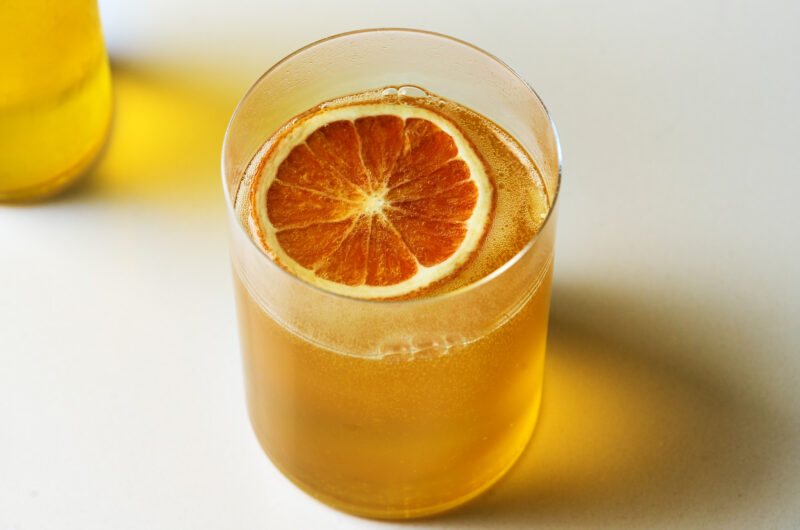
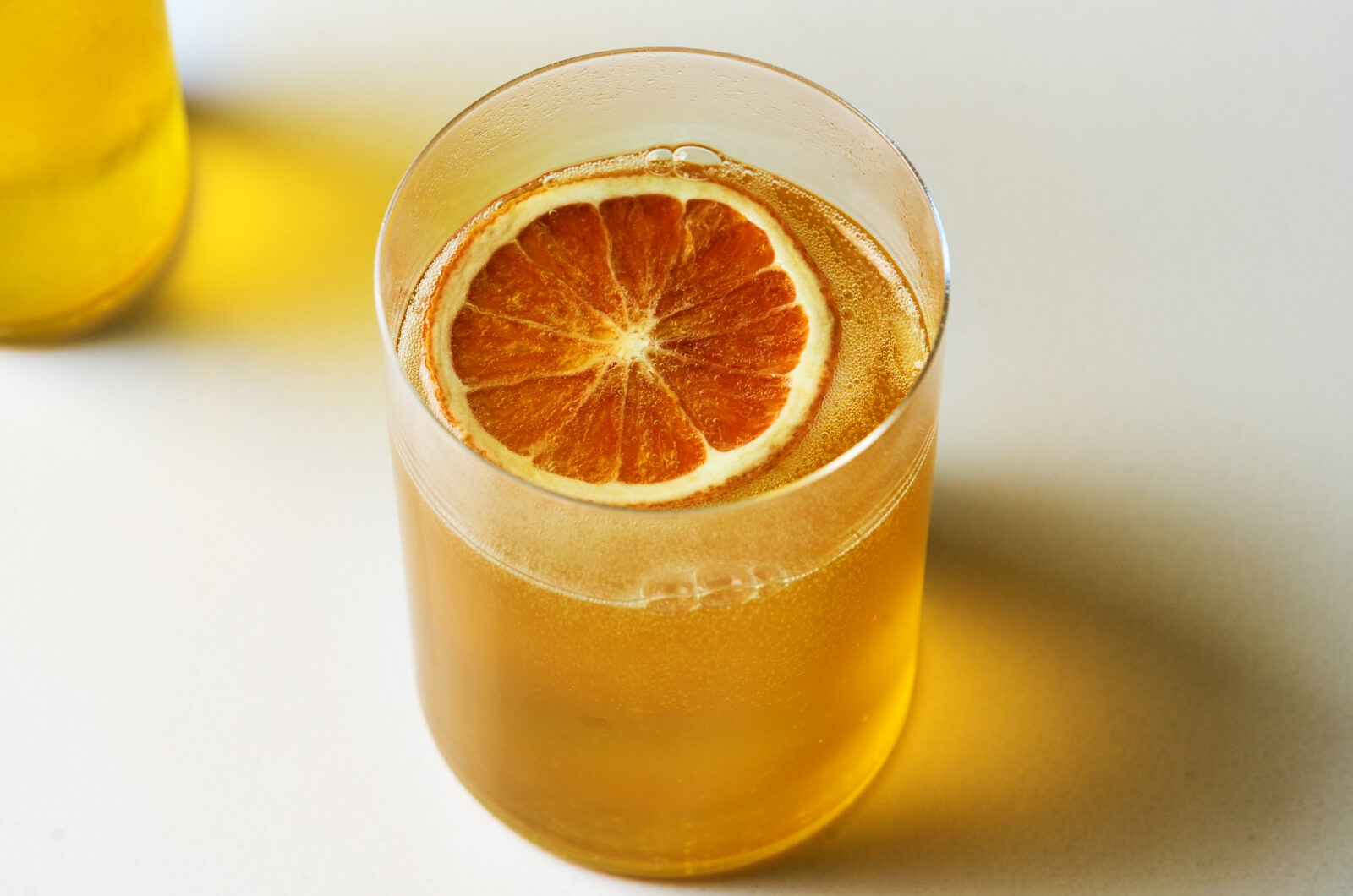
Tropical kombucha that tastes like vacation, without needing to “quit your job and move to Maui.”
While most people are stuck on using black tea and adding juice to flavor it, we moved on to making kombucha out of exotic teas that creates something so delicious you will want to bottle and sell it. We brew a strong Maui Mango sweet tea, then let a healthy SCOBY do its thing. After the first ferment it’s already delicious—but why stop there? It gets transferred to bottles for a second ferment to make it fizzy, soda-like tropical drink.
9
20
minutes45
kcal84
hours84
hours20
minutesTropical kombucha that tastes like vacation, without needing to “quit your job and move to Maui.”
Ingredients
310 g 1 1/2 cups 1 Tbsp cane sugar
60 g 1/2 cup Maui Mango tea loose leaf
2000 g 8 1/4 cups filtered water, divided
225 g 7/8 cup kombucha
1 1 SCOBY
Equipment
Directions
Before We Start
Temperature drives timing: This recipe is written around 82°F (28°C). Cooler kitchens take longer; warmer spaces go faster.
Adding Kombucha: Ideally you would use kombucha from a previous batch. If it is your first go at this, use the liquid that came with your scoby. The addition drops the pH level and helps jump start the fermentation process.
Maui Mango Tea: We discovered this tea at an organic grocery store in town, but found the exact thing on Amazon.
Fermentation Time: You can make it in 3.5-5 days, but if you want it to be fizzy add another 5-7 days on top of that.Dissolve the Sugar
In a 3 qt pot, heat 600 g (2 1/2 cups) filtered water with 310 g (1 1/2 cups + 1 Tbsp) cane sugar until the sugar fully dissolves, about 4-5 minutes.Steep the Tea
Turn off the heat and add 60 g Maui Mango tea directly to the pot. Steep for 10–15 minutes.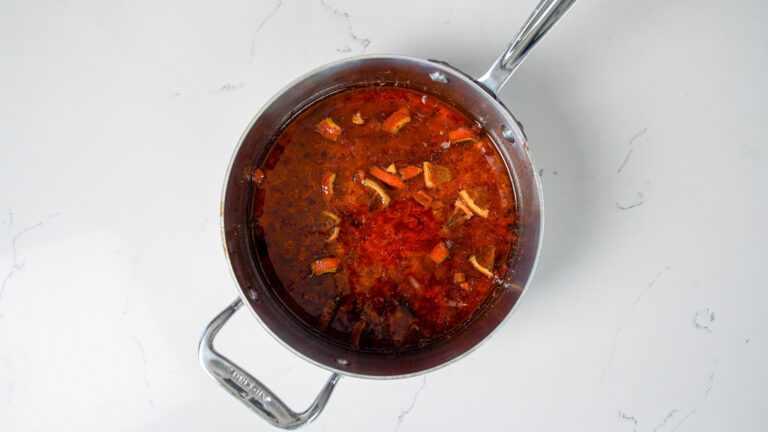
Strain Into the Fermentation Jar
Set a fine-mesh strainer over your clean 1-gallon jar and line it with cheesecloth or muslin. Carefully strain the sweet tea into the jar.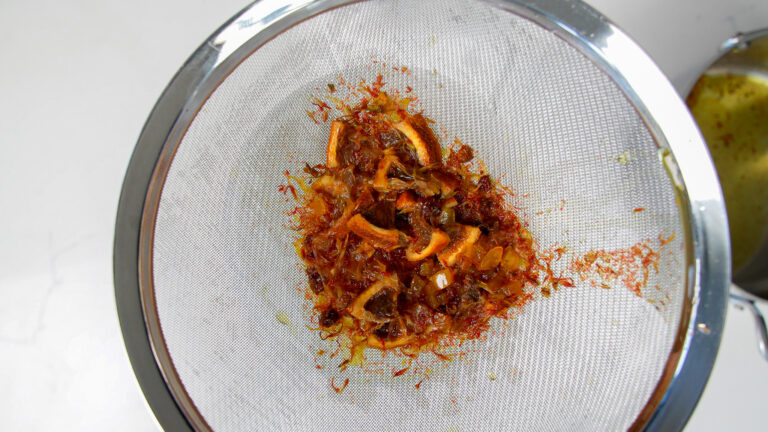
Dilute and Cool
Add the remaining 1400 g (5 3/4 cups) cold filtered water to the jar to dilute and bring the temp down.
You want this around room temperature before adding your culture. If you added cold water, you shouldn’t need to wait before proceeding with the next step. It’s worth noting because high temps can kill your scoby.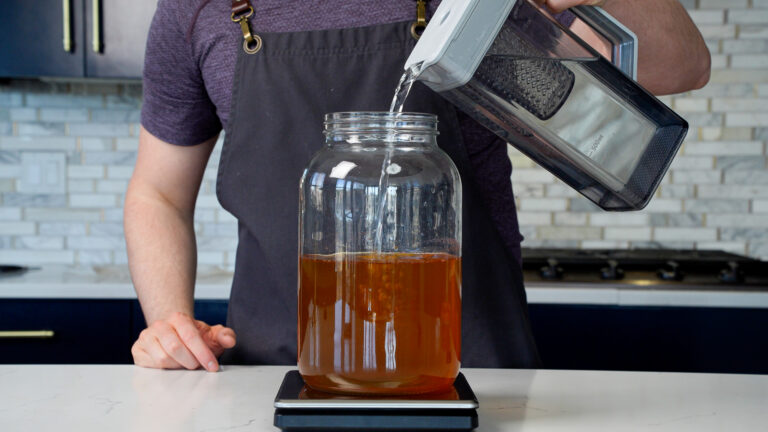
Add the Starter Kombucha
Add 225 g (~7/8 cup) starter kombucha to the jar and gently stir with a clean utensil.Add the SCOBY
Gently add the SCOBY to the jar.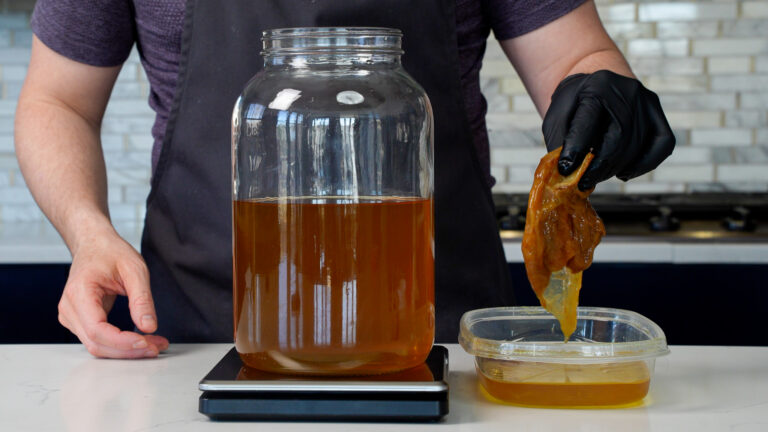
First Ferment
Cover with a breathable cloth and rubber band it (we’re fermenting tea, not inviting fruit flies). We like using a high quality cheese cloth for this. Then transfer to a fermentation chamber or seedling mat setup to ferment.
Fermentation Chamber: You can make a DIY fermentation chamber using a temperature controller, chicken lamp or seedling/reptile mat, and a cooler. This is my preferred setup because it is so accurate. It is also great for proofing dough. Just plug your heat source to your temperature controller and set it inside the cooler along with your food. Set yours to 82°F (28°C) with 2°F (1°C) tolerance.
Seedling Mat: A cheap and simple setup is a seedling heat mat with a trivet/rack on top (so the jar isn’t sitting directly on the mat), plus a small thermometer. Set your jar on top of the trivet and check the temp after about 8-12 hrs just to make sure the kombucha is between 78°F (26°C) – 85°F (29°C).
Ferment at 82°F (28°C) for 3.5–5 days:
3.5 days: sweeter, less acidic
4 days: ideal at 82°F (28°C)
5 days: more acidic, or helpful if you’re fermenting a bit cooler
Start tasting around day 3-4. When it’s lightly tart and still a little sweet (not harsh), you’re ready to drink—or ready to bottle.
With gloves or tongs, remove the SCOBY and transfer to an air tight container. Add about 350 g of kombucha from your batch. Place in the fridge for when you are ready to use again.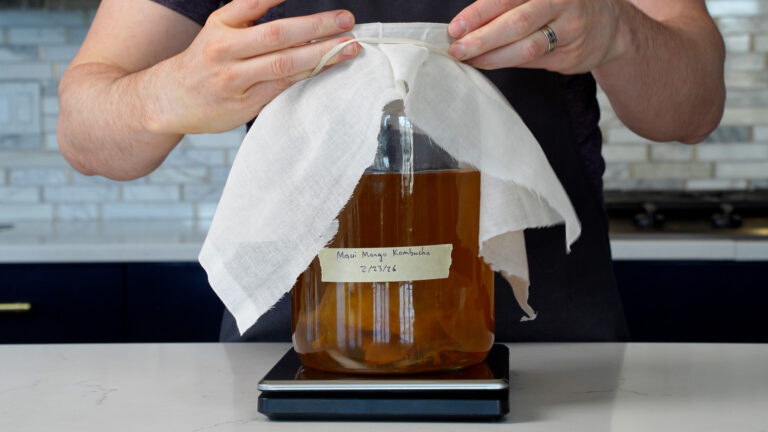
Carbonate! (Optional)
We love it carbonated, it’s like a tropical soda. If you want it bubbly, pull it slightly sweeter than where you may want it to be for the final product.
Set a funnel in a swing-top bottle and lay a piece of cheesecloth/muslin over the top of the funnel as a final filter while you bottle. Fill the bottle and cap it off. Repeat with additional bottles until you have bottled all your kombucha.
Let the bottles ferment at 82°F (28°C) for 6 days (ideal).
Temp note: If you’re closer to 78°F (26°C), plan on 7 days for similar fizz. If you’re warmer than 82°F (28°C) or you just want lighter carbonation, 5 days can be enough.
Note: Some bottles hold carbonation better than others, at about 5-6 days take one bottle, let it chill for a few hours in the fridge, then open it to ensure it is well carbonated. If it is, then you are ready to move onto the next step. If it isn’t carbonated enough, let the remaining bottles of kombucha continue fermenting for an extra day or two.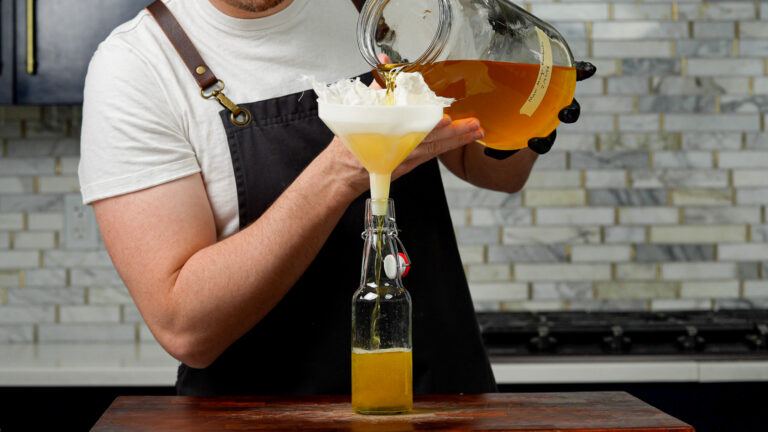
Chill and Serve
If you are skipping carbonation, then set a funnel in a swing-top bottle and lay a piece of cheesecloth/muslin over the top of the funnel as a final filter while you bottle. Fill the bottle and cap it off. Repeat with additional bottles until you have bottled all your kombucha. Transfer them to the fridge.
If carbonating, once it’s as carbonated as you like, move bottles to the fridge. Serve cold.
Once chilled, enjoy on the beach, with some Hawaiian pork or seafood.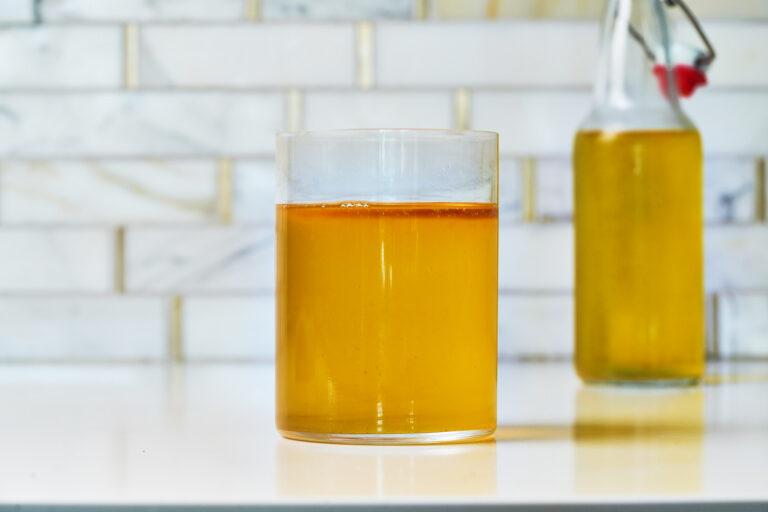
You May Like These Recipes Too
Additional Details About This Recipe
Do I have to do the second ferment?
Nope. After the first ferment, it’s ready to drink—it’ll just be closer to a lightly tart iced tea than a soda.
How do I keep kombucha at 82°F (28°C) without a fermentation chamber?
A simple setup is a seedling heat mat with a trivet/rack on top (so the jar isn’t sitting directly on the mat), plus a small thermometer. It’s cheap, stable, and does the job.
How do I know when the first ferment is done?
Taste is the real meter. Start around day 3. If you want to do a second ferment, stop the first ferment a touch sweeter than your ideal final drink.
Can I ferment at room temperature instead of 82°F (28°C)?
No. It needs to be between 78°F (26°C) – 85°F (29°C). Brewing at room temp for kombucha is likely to develop mold.
What if I don’t have starter kombucha from a prior batch?
Use raw, unflavored store-bought kombucha as a starter in a pinch (the more acidic the better). Don’t use flavored kombucha as your starter.
Why strain through muslin/cheesecloth?
It catches tea particles so they don’t turn into “mystery floaters” in the finished drink. Your SCOBY will still form a new pellicle during fermentation either way.
How do I know if it’s mold?
Mold is dry/fuzzy and forms distinct colonies. Normal kombucha growth is wet/glossy and often beige or tan. When in doubt, toss it—mold isn’t worth gambling on, but if you follow our steps and temperature guide, you shouldn’t have a mold issue.
Nutritional Facts (per 8 oz)
(Values are estimates. Kombucha nutrition varies widely based on fermentation time and how much sugar remains.)
- Calories: 45 kcal
- Protein: 0 g
- Fat: 0 g
- Saturated Fat: 0 g
- Carbohydrates: 11 g
- Sugars: 10 g
- Fiber: 0 g
- Cholesterol: 0 mg
- Sodium: 10 mg